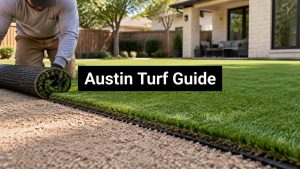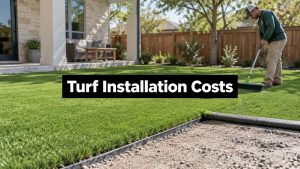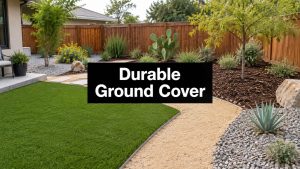

Backyard turf installation in Austin typically costs USD 5 to USD 20 per square foot, and that's a wide range for a reason. The difference usually comes down to site prep, drainage, access, materials, and whether the installer is building a lawn that still looks good years from now or just one that looks good on day one.
If you're reading this, there's a good chance your yard has already put you through the usual Austin cycle. Brown patches in summer. Mud after a hard rain. A sprinkler bill that feels unreasonable. Maybe the grass grows in one area and dies in another because the yard never drains evenly. Maybe you're tired of mowing a lawn that still never looks finished.
A good backyard turf installation solves those problems, but only if it's treated like an outdoor system, not a carpet roll. In Texas, heat exposes cheap materials fast, and stormwater exposes bad prep even faster. The homeowners who end up happy with turf long term usually make the same decision early. They stop shopping for the lowest bid and start asking better questions about drainage, grading, seams, infill, and base construction.
Why Austin Homeowners Are Switching to Artificial Turf
Austin lawns take a beating. The sun is intense, watering rules can change, and many yards sit on soil that turns hard when dry and slick when wet. Homeowners don't just get frustrated with appearance. They get tired of spending money on a lawn that keeps asking for more.

It solves local problems natural grass often can't
A lot of backyard turf installation decisions come from the same practical issues:
- Water pressure on the budget: Homeowners want a green yard without constant irrigation.
- Mess after storms: Kids, dogs, and patio traffic turn weak grass into mud quickly.
- Weekend maintenance: Mowing, edging, fertilizing, weed control, and reseeding never really stop.
- Patchy results: Even with effort, many Austin lawns still look inconsistent because of sun exposure, drainage, and soil conditions.
Artificial turf changes the equation. You trade recurring lawn frustration for a surface that stays usable, looks consistent, and doesn't depend on perfect weather.
That shift isn't niche anymore. The global artificial turf market is projected to reach USD 13.16 billion by 2031, with outdoor grounds applications projected to grow at a 14.62% CAGR, and North America held 37.74% of the global market share in 2025 according to Mordor Intelligence's artificial turf market report.
Homeowners aren't just buying grass
They're buying back time and predictability.
When a yard stays green through heat, doesn't turn into sludge after rain, and doesn't need a mower every week, the space gets used more. Families spend time outside instead of managing the lawn. Pet owners stop fighting bare spots. Entertaining gets easier because the yard looks finished without a rush cleanup.
A turf lawn should make your property easier to live with. If it adds maintenance headaches, the install was wrong or the material choice was wrong.
The important part is this. Turf isn't automatically a smart investment just because it's low maintenance. It becomes a smart investment when the installer understands Austin conditions and builds for them. A flat, dry showroom sample tells you almost nothing about how that product will perform over hot summers, compacted clay, runoff, and foot traffic in a real backyard.
The Anatomy of a Perfect Turf Installation
A lasting turf lawn has more in common with a house slab than most homeowners realize. What you see on top matters, but the hidden layers decide whether the surface stays smooth, drains properly, and holds its shape.

The base is the real foundation
The turf fibers get the attention because they're visible. The base does the hard work.
A proper system starts with excavated ground, shaped for drainage, then rebuilt with compacted aggregate. That layer supports the lawn, controls movement, and keeps the surface from developing soft spots and dips. If the base is uneven or loosely compacted, the finished turf will eventually telegraph every mistake.
Cheap installs often fail in predictable ways:
- Loose base material leads to settling.
- Poor grading leaves low spots that hold water.
- Rushed compaction causes seam stress and surface waves.
- Thin prep work saves money upfront and costs more later.
The turf face and backing have to match the yard's use
Not every homeowner needs the same product. A showpiece backyard, a pet run, and a side yard walkway should not all get the same turf.
The visible turf layer includes the blades, backing, and often a thatch layer that helps the surface look more natural and keeps it from appearing flat. Some products are built for a softer, more ornamental look. Others are built to take abuse from kids, dogs, and repeated traffic.
When I look at a yard, I'm not just asking what color green the homeowner likes. I'm asking how the yard gets used, where the sun hits hardest, where furniture sits, where dogs pace, and whether the owner wants a soft visual lawn, a practical play area, or both.
Infill is not an afterthought
Infill helps support the blades, improve footing, and affect how the surface handles heat and drainage. Skipping it or underapplying it usually leads to flattening and a less stable feel underfoot.
Practical rule: If someone sells you turf as “just roll it out and pin it down,” they're not describing a professional backyard turf installation.
Think of the system in layers:
| Layer | What it does | What happens if it's done poorly |
|---|---|---|
| Compacted sub-base | Supports the whole lawn | Settlement, dips, movement |
| Drainage layer | Moves water away | Standing water, soggy edges |
| Infill | Supports fibers and affects performance | Matting, unstable footing |
| Artificial turf | Delivers appearance and use surface | Premature wear if mismatched |
Homeowners usually compare products by feel first. Installers should compare them by fit for the site.
Mastering Site Prep and Drainage for Texas Weather
In Central Texas, site prep is where a backyard turf installation either gets built right or is prone to failure. Most of the expensive callbacks in this industry come from what's under the turf, not the turf itself.
Austin yards add a few complications. Many have heavy clay soil. Some take runoff from neighboring lots. Others look mostly flat until one hard storm shows you exactly where the water wants to sit. If that behavior isn't corrected before the turf goes in, the new lawn hides the problem for a short time.
Excavation depth and compaction matter
A professional installation requires excavating 2.5 to 4 inches and installing a road base compacted to around 90% Standard Proctor according to Lowe's artificial grass installation guide. Those details matter because a stable, compacted base resists shifting and supports proper drainage over time.
That's why experienced crews don't dump one thick layer of base and hope for the best. They build in lifts, compact repeatedly, and check grade as they go. That process takes longer, but it's how you avoid the lawn that looks smooth at install and uneven a season later.
For homeowners who want to understand why excavation quality matters before they even get to turf, Treecorp Solutions excavation tips give a useful general overview of how digging, access, and subgrade conditions affect the finished result on outdoor projects.
Drainage has to be engineered into the yard
A lot of installers talk about drainage as if turf automatically solves it. It doesn't.
Turf can pass water through the surface, but the entire system still needs a path for water to move away from the area. On some lots, a properly graded aggregate base is enough. On others, the yard needs added runoff planning, edge relief, or a broader water-management strategy beyond the lawn itself. If your property already has pooling issues, it's smart to look at yard drainage solutions before finalizing the turf layout.
Common trouble spots include:
- Fence lines: Water gets trapped with nowhere to exit.
- Low corners: These collect runoff from patios, roofs, and neighboring grades.
- Downspout discharge areas: Concentrated flow can undermine edges.
- Transition zones: Turf beside pavers, concrete, or flower beds needs clean water movement.
Most turf drainage problems start before the turf is unrolled. They start when someone ignores where the water is already going.
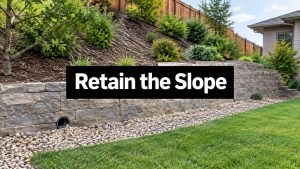
Slopes expose weak workmanship fast
Flat yards are simpler. Sloped yards separate experienced installers from crews that only know the basics.
On a slope, the base has to be shaped carefully and the turf needs to be anchored with more attention at the perimeter. If that's done poorly, the surface can wrinkle, shift, or create runoff problems that get worse with time. In Austin, where one section of a backyard can stay dry for weeks and another can get hammered by stormwater in a single evening, slope work can't be improvised on site.
A careful installer studies access, grade transitions, and water movement before quoting the project. If a bid skips those questions, that's not efficiency. That's a warning sign.
Choosing Your Turf Materials and Infill Options
By the time homeowners reach the material stage, a lot of them have already seen half a dozen samples that all look good in the hand. Then August hits, the yard gets full afternoon sun, the dog runs the same path every day, and the product choice starts to matter a lot more than it did in the showroom.
In Austin, turf selection is less about picking the prettiest blade and more about avoiding the wrong system for the way the yard will be used. The expensive mistakes usually show up later. Flattened traffic lanes, a surface that runs hot, pet areas that hold odor, or seams and edges that age faster because the backing and face weight were chosen for price instead of performance.
Turf style should match how the yard lives
Start with use. A front-facing lawn that is mostly for appearance can handle a different product than a backyard where kids, dogs, and patio traffic hit the same spots every week.
For a general residential lawn, I usually look for a turf with enough thatch to break up the artificial look, plus enough density to keep the blades standing after regular foot traffic. For pet zones, durability and cleanability matter more than a soft showroom feel. For putting greens, the conversation changes completely. Ball roll, firmness, and sub-base precision matter more than lawn-style appearance.
A few material details deserve close attention:
- Pile height: Mid-range heights usually wear more consistently than very tall products in active backyards.
- Face weight and density: More fiber generally gives better body and visual coverage, but it can also raise cost and change how the turf feels underfoot.
- Thatch color and blend: Good thatch helps the turf read more naturally in Texas light and supports the blades.
- Backing strength: Better backing holds seams, handles movement at transitions, and supports long-term stability.
- Perforation pattern: Drainage capacity matters, especially in pet areas and yards with mixed sun and shade.
If you want to compare appearances and intended use side by side, artificial grass types for residential yards can help narrow the field before you request samples.
Infill changes performance more than many homeowners expect
Infill is not an afterthought. It affects how the turf stands up, how it drains, how much heat it holds, and how comfortable it feels during daily use.
That is why the cheapest infill package on a proposal can become the most expensive decision over time.
Guidance on hot-climate and uneven-ground installations also points to infill selection as a major factor in drainage and surface temperature, as discussed in Premium Grass Blades' installation guidance. In Austin, that matters because one backyard may have heavy sun exposure for ten hours while another gets partial tree cover and much lighter surface heat.
| Infill Type | Key Benefit | Best For | Cost |
|---|---|---|---|
| Silica sand | Adds ballast and supports blade position | Standard residential lawns | Lower |
| Antimicrobial infill | Helps manage pet-use hygiene concerns | Dog runs and pet areas | Higher |
| Cooling-focused infill | Improves comfort in strong sun | Full-sun yards in hot climates | Higher |
| Performance-focused blends | Balances support, drainage, and comfort | Multipurpose family yards | Mid to higher |
The best choice depends on the trade-offs you can live with
Every material decision has a trade-off. Taller, softer turf can look great on day one but may show traffic paths sooner in an active yard. Dense products usually look better longer, but they can cost more and may need more brushing to keep the fibers upright. Cooling infills can improve comfort, but they add cost that may not pencil out for a shaded yard.
Pet turf needs especially honest planning. Homeowners often focus on softness and color, then regret choosing a product that is harder to rinse thoroughly or does not pair well with a pet-specific infill. In those yards, I would rather specify a slightly firmer system that cleans well and drains fast than a plush product that creates more maintenance headaches.
The same applies to budget choices. Saving on fiber quality or infill can look smart on the bid sheet, but if the lawn mats down, traps odor, or feels too hot to use, that lower price does not hold up very well over the life of the installation.
What usually works well in Austin
The strongest residential systems here tend to share a few traits. They use a realistic-looking turf with enough thatch to avoid the plastic sheen, a backing that can handle long-term use, and an infill matched to sun exposure, traffic, and whether pets use the yard.
Problems usually come from mismatches:
- Decorative turf in a high-traffic yard: The surface can flatten and wear unevenly.
- Low-cost infill in full sun: The lawn may become less comfortable during peak heat.
- Pet use without pet-focused materials: Odor control and cleanup get harder.
- Buying by sample feel alone: Small showroom pieces do not show how the full yard will perform after months of weather and use.
Good material selection protects the investment you make in the base work underneath. In Austin, that matters. A turf system should still look and function like it belongs there after summers of heat, sudden storms, and regular backyard use.
Understanding Backyard Turf Installation Costs in Austin
The question almost every homeowner asks first is simple. What's this going to cost me?
The honest answer is that professional turf installation typically ranges from USD 5 to USD 20 per square foot, with labor alone often cited at USD 3 to USD 9 per square foot, and grass removal can add USD 0.88 to USD 1.84 per square foot according to the cost ranges summarized in this research review on synthetic turf development and installation economics. That's why two yards with the same square footage can price very differently.

What actually drives the number
Square footage matters, but it's only one part of the bid.
The biggest cost drivers usually include:
- Existing lawn removal: Replacing live grass adds labor and disposal work.
- Access to the backyard: Tight side yards and limited equipment access slow everything down.
- Drainage correction: Yards with runoff or pooling need more than a basic install.
- Material choice: Not all turf products and infills are priced the same.
- Edges and custom features: Curves, borders, steps, pet zones, and greens add labor complexity.
For larger residential work, one analysis cited in that same review notes a 1,000-square-foot installation may cost USD 3.45 to USD 12 per square foot depending on complexity and material choice. That range tells you something important. The cheaper number usually assumes a simpler site. The harder the yard, the less useful bargain pricing becomes.
Cheap bids usually cut the invisible parts
Homeowners often compare quotes based on the top-line price. I'd compare them based on the hidden scope.
Ask whether the bid includes full excavation, haul-off, proper base depth, compaction, seam work, edging, infill, and drainage corrections where needed. If one quote is far lower than the others, someone is usually trimming labor, prep, or materials. Those are the exact areas that determine lifespan.
If you don't know what the installer is doing below the turf, you don't really know what you're buying.
Budget for value, not just installation day
Turf is a front-loaded investment. Natural grass spreads its cost over time through water, mowing, treatments, repairs, and ongoing frustration. Turf shifts more of the spending to the beginning, but the payoff is consistency and lower routine upkeep.
If you want a more detailed breakdown of what affects project pricing locally, this guide on the cost of artificial turf is a practical resource.
The right way to think about cost isn't “What's the cheapest lawn I can buy?” It's “What's the lawn I won't have to redo?”
Beyond the Lawn Custom Putting Greens and Pet Turf
Some of the most rewarding backyard turf installation projects aren't basic rectangular lawns. They're spaces built around how the homeowner lives.
A golfer may want a green that rolls cleanly and looks integrated into its surroundings. A pet owner may need a yard that drains fast, stays usable after rain, and doesn't turn into a dirt track near the back door. Those are different systems with different priorities.

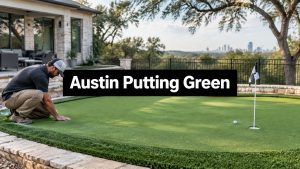
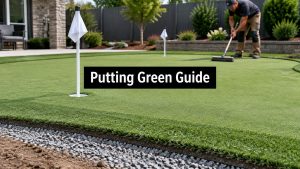
Backyard putting greens need precision
A putting green isn't just turf with a cup cut into it.
The sub-base has to be cleaner and more controlled because roll quality depends on surface consistency. Transitions matter. Seams matter. The fringe and surrounding lawn should complement the green instead of making it feel dropped in as an afterthought.
Homeowners interested in that kind of project usually benefit from looking at dedicated backyard putting green installation examples, because the design and construction choices are different from a standard yard lawn.
Pet turf should be built for cleanup and drainage
Pet turf works well when the system is designed around pets from the start. That means durable fibers, good drainage through the build, and an infill strategy that supports easier cleaning.
A few things make a pet area perform better:
- Fast drainage paths: Waste cleanup is easier when the system doesn't hold moisture.
- Resilient yarn shape: Dogs create repeated pacing patterns near doors and fence lines.
- Practical layout: It helps to think about shade, rinsing access, and where pets run.
I've seen homeowners make the mistake of choosing turf based only on softness in the sample book, then regretting it when the dog path wears the look unevenly. A pet system should still look good, but it has to be selected for traffic and cleanup first.
The best specialty turf projects feel obvious once they're finished. The yard looks like it was always meant to function that way.
Custom turf is at its best when it solves a specific lifestyle problem, not when it just adds novelty.
How to Choose the Right Austin Turf Installer
The installer matters as much as the product. In many cases, more.
A strong turf product installed poorly will still fail. Seams separate. Edges lift. Water sits where it shouldn't. The lawn looks great for a few months, then the problems start showing. That's why homeowners should vet the company, not just the sample board.
Ask questions that reveal real experience
Start with the basics, then go deeper.
- Insurance and warranty: Ask what's covered and what isn't.
- Local project history: Ask to see completed work in Austin-area conditions.
- Prep process: Ask how they handle excavation, base build, compaction, and drainage.
- Slope experience: Ask how they approach uneven yards and grade transitions.
- Crew responsibility: Ask who performs the install and supervises the work.
A key differentiator for expert installers is the ability to handle complex sites, especially sloped yards that require extra fasteners, careful base shaping, and specialized techniques to prevent wrinkling and maintain drainage over time, as shown in this slope installation demonstration on YouTube.
Watch for vague answers
Good installers answer directly. Weak ones stay general.
If someone can't explain how they manage water flow, how they anchor on slopes, or what they do differently on clay-heavy properties, they may not understand the site well enough to price it accurately. Homeowners usually hear polished sales language first. The better test is whether the company can talk clearly about sub-base, seams, edges, and runoff.
Here's the checklist I'd use if I were hiring for my own home:
- Can they explain the base build in plain English?
- Do they inspect drainage instead of assuming the yard is fine?
- Can they point to local installs with similar site conditions?
- Do they discuss material trade-offs fully, including heat and pet use?
- Does the proposal describe scope clearly enough to compare bids line by line?
That process protects you from the cheapest mistake in this industry. Hiring someone who only knows how to install turf on an easy yard.
Your Austin Turf Questions Answered
Does artificial turf last
Yes, if the system under it is built right.
In Austin, turf life is usually decided below the surface. Clay movement, poor runoff, weak edges, and bad seams shorten the life of the lawn long before the fibers wear out. A well-prepared base with the right turf for the way the yard is used will hold up for years. A rushed install can look fine at first and start failing after a few hot summers and heavy storms.
Will turf help my property look more finished
Usually, yes.
A clean turf area can make a yard look sharper and easier to maintain, especially where natural grass struggles in heat, shade, or dog runs. The difference is in the details. Tight edging, realistic blade color, and clean transitions to patios, beds, and walkways are what make it look intentional instead of fake.
Can turf work with HOA requirements
Often yes, but check the rules before any work starts.
Some Austin HOAs care less about the backing or fiber and more about how the finished yard looks from the street. They may want approved edging, limits on front-yard use, or a certain appearance near sidewalks and driveways. It is much easier to confirm that up front than to fix a rejected install later.
Is turf a good idea for families with dogs and kids
Yes, if it is built for traffic and cleanup.
A play yard, a dog run, and a decorative patch near a patio should not all be built the same way. Pet areas need better drainage and odor control. Kid-heavy zones need a stable surface that stays smooth under hard use. In full Austin sun, material choice matters too, because some products run hotter and wear differently than others.
If you want direct answers about your yard, schedule an on-site consultation. Modern Yard handles backyard turf installation in Austin with close attention to drainage, base prep, material fit, and long-term performance, so you can see what your yard needs before you commit.