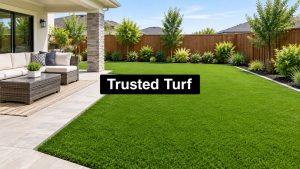

A lot of Austin homeowners end up in the same spot. They want a backyard that looks sharp, stays usable through heat and rain, and doesn’t demand constant watering, mowing, or patching. They also want something that feels more purposeful than a plain rectangle of lawn.
That’s where a backyard putting green starts to make sense. Done right, it isn’t just for golfers. It creates a cleaner focal point, gives the yard a built-in activity area, and replaces a piece of the outdoor space that often underperforms in Austin conditions.
The catch is simple. A putting green is easy to underestimate. From the surface, it looks like turf and a few cups. Underneath, it’s grading, compaction, drainage, contouring, and material choices that determine whether the green rolls cleanly for years or starts failing after the first stretch of heavy weather.
The Ultimate Upgrade for Your Austin Backyard
A backyard putting green works best when it solves more than one problem at once. It gives you a practice area, but it also replaces thirsty lawn space with a cleaner, lower-maintenance feature that stays visually consistent through the seasons. In Austin, that combination matters.
Many backyards here fight the same battle. Summer heat stresses natural turf. Clay soil holds water in the wrong places. Then a strong rain exposes every weak point in grading and drainage. Homeowners end up with a yard that’s expensive to maintain and still not that enjoyable to use.
A well-designed putting green changes that equation. It creates a defined destination in the yard. Kids use it differently than golfers do. Guests gather around it. And because the surface is intentional, the space feels finished instead of temporary.
A putting green earns its place when it improves the whole backyard, not just one hobby.
The best projects also fit into the broader outdoor area. Fringe turf, pathways, seating, lighting, and drainage all matter. If you’re weighing ideas beyond golf alone, these backyard turf ideas for Austin homes help show how a green can become part of a complete outdoor plan instead of a standalone add-on.
This isn’t the cheapest backyard upgrade. It can be one of the smartest if the design matches the property and the base is built right.
Designing Your Perfect Putting Green
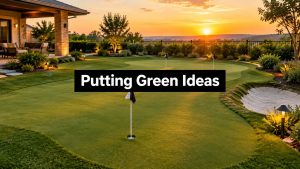
A good backyard putting green starts with the right level of ambition. Some homeowners want a clean practice target. Others want multiple cup locations, short chip shots, and contours that make the surface feel closer to a course green. Both can work. Problems start when the design doesn’t match the yard, the budget, or the way the space will get used.

Start with the size that fits your yard
Many installers group a backyard putting green into three practical sizes: small at about 150 to 300 square feet, medium at 300 to 500 square feet, and large at 500 to 1,500+ square feet, with larger greens able to support more varied slopes and chipping areas, according to Golf.com’s backyard putting green guidelines.
That breakdown is useful because it keeps the design grounded.
- Small greens work for basic repetition. They’re a strong fit when the goal is putting practice without taking over the whole yard.
- Medium greens usually create the best balance for family use. They offer enough area for multiple cup positions and more interesting breaks.
- Large greens open up the fun stuff. Wider contours, approach angles, collar turf, and a layout that feels more immersive.
If you’re looking at local examples, artificial turf putting green options in Austin can help you compare what these layouts look like in real residential settings.
Design for play and for the property
The shape of the green matters as much as the square footage. An awkward oval dropped into the yard rarely feels custom. A green that follows the space, respects sightlines, and connects to patios or planting beds feels intentional.
A few design choices usually separate average projects from strong ones:
- Cup placement: One hole gets old fast. Multiple cup positions keep the green useful.
- Contours: Gentle breaks are better than exaggerated mounds. Overbuilt undulations often look fake and make the surface less enjoyable.
- Fringe and chipping areas: These expand how the green gets used and soften the transition into the rest of the surrounding area.
- Edge treatment: Steel edging, stone borders, and planting beds affect both cleanup and appearance.
Sloped yards need extra care. In some properties, retaining work becomes part of the putting green plan. If you want a good visual primer on how grade changes can be managed, this guide to retaining wall design by Retaining Wall Supplies is useful for understanding how level changes influence layout decisions.
Practical rule: The best design is the one you’ll use often, not the one that tries to copy a country club in a tight backyard.
Material selection matters too, especially in Austin. You want turf built for putting performance, but you also want fibers and construction that can stand up to strong sun exposure and regular foot traffic. The visible surface gets the attention. The shape, edges, and traffic flow decide whether the green feels easy to live with.
The Unseen Workhorse The Critical Base and Drainage
A backyard putting green can look finished on day one and still be headed for problems. In Austin, I see that happen when the visible turf goes in over a base that was rushed, underbuilt, or drained like a flat lawn instead of a precision surface. Clay soil, long summer heat, and sudden heavy storms expose those shortcuts fast.

Drainage has to be engineered, not assumed
Water management decides whether the green stays true. The USGA putting green construction standards call for lateral drain pipes spaced no more than 15 feet apart, or less than 10 feet apart in native soil, inside a 6-inch-wide, 8-inch-deep trench, with a minimum continuous slope of 0.5 percent.
Those details matter more in Austin than they do in easier soils. Our clay tends to hold water, then shrink and move during dry periods. If the drainage layout is too sparse or the pitch is off, water lingers under the surface, soft spots develop, and ball roll gets inconsistent.
Compaction matters just as much. Homeowners who want a simple explanation of why subgrade stability affects the finish surface can get a useful primer from this article on soil compaction for driveways. The application is different, but the lesson holds up. If the soil underneath shifts, the surface above it follows.
The base does the real performance work
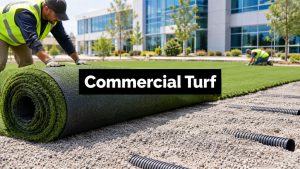
A putting green base is a built system. It needs enough excavation depth to fit the full profile, a subgrade that holds shape, aggregate placed correctly, and a top layer that supports consistent roll instead of random settling.
For residential projects, that does not always mean copying a tournament specification line for line. It does mean respecting the same principles. Water needs a path out. Materials need to be installed in the right order. Each layer needs to support the one above it.
Crews usually get into trouble in three places:
- Excavation that is too shallow: The system gets squeezed from the start, which limits drainage and weakens the profile.
- Poor aggregate placement: Gravel should move water across the base toward collection points, not just fill a hole.
- Loose compaction practices: If lifts are too thick or the crew skips proper passes, the green can settle unevenly after rain and foot traffic.
What holds up in Austin
The best builds are disciplined, not flashy. They start with careful grading, account for runoff entering the area from the rest of the yard, and give collected water somewhere to discharge. Edges also matter. If the perimeter unravels, the clean finish disappears and maintenance gets harder.
The failures are predictable too:
- Flat drainage planning on lots that already move water toward the green
- Overbuilt contours that trap moisture in low pockets
- Fill dumped in quickly instead of compacted in controlled lifts
- Base work sized for appearance instead of long-term use
If the property already has standing water or runoff cutting through the yard, address that first. In many Austin projects, broader yard drainage solutions for Austin properties need to be part of the overall property plan so the green is not asked to fix a site-wide water problem by itself.
A smooth putt starts below the turf.
That is why experienced installation matters here. Homeowners usually shop the visible surface first. Professionals look at excavation, subgrade behavior, drainage routing, and how the base will respond after a hot August followed by a hard storm. That approach costs more upfront, but it usually costs less than rebuilding a green that never had the right foundation.
Choosing Your Path DIY vs Professional Installation
A lot of Austin homeowners reach this point after the same experience. They price out a backyard putting green, watch a few install videos, and wonder whether the labor markup is worth it. Sometimes it is not. If the goal is a small, simple practice strip on a forgiving part of the yard, a skilled DIYer can pull it off.
A true putting green is less forgiving than it looks. On Central Texas clay, small errors in grade, compaction, or drainage usually show up after the first stretch of heat and the first hard rain.
DIY vs Professional Putting Green Installation
| Factor | DIY Approach | Professional Installation (Modern Yard) |
|---|---|---|
| Upfront spending | Lower labor cost on paper, but equipment rental, spoil removal, wasted material, and corrections can close the gap | Higher initial investment, with excavation, shaping, drainage, and finish work handled as one build |
| Base preparation | Depends on your ability to excavate evenly, compact consistently, and keep elevations true | Installed with dedicated equipment and a repeatable process that holds tolerances better |
| Drainage planning | Easy to underestimate on Austin lots with runoff, tight side yards, or heavy clay | Planned around soil behavior, slope, discharge points, and stormwater patterns |
| Surface quality | Good enough for simple shapes in some yards, but contours, cup placement, and seams are harder to get right | More consistent roll, cleaner edges, and a more polished finished look |
| Time commitment | Often spreads across several weekends and weather delays | Built on a defined schedule with fewer interruptions |
| Risk of correction | Higher if the surface settles, wrinkles, or starts holding water | Lower because the green is installed as a full outdoor system, not just turf over fill |
The practical difference is not just labor. It is error tolerance.
DIY jobs usually get into trouble in four places:
- Excavation and grade control: The surface can look right to the eye and still putt wrong.
- Compaction: Rental machines help, but they do not tell you whether each area is uniform.
- Drainage layout: Pipe slope, outlet location, and runoff entering from the rest of the yard are easy to miss.
- Finish work: Seams, cup setting, edge restraint, and fringe transitions separate a backyard project from a custom install.
Austin makes those mistakes more expensive. Summer sun bakes the surface, clay expands and contracts, and sudden storms test every low spot. A green that looks fine on install day can start showing soft areas, minor edge movement, or puddling once the weather cycles through a full season.
I tell homeowners to be honest about the goal. If you want a casual practice area and do not mind a few imperfections, DIY may be a reasonable choice. If you want consistent speed, clean appearance, and fewer surprises after the next heavy rain, professional installation usually pencils out better over time.
Material selection plays into that decision too. Homeowners comparing surfaces and finish levels can get a clearer sense of pricing by reviewing the cost of artificial turf for residential projects.
Foundation decisions in any outdoor build follow the same logic. This piece on why Firm Foundations helps with your foundation choices is useful because it frames the trade-off clearly. You are paying for a lower chance of correction later, not just for extra hands on site.
Estimating Your Backyard Putting Green Cost
Cost matters, and homeowners deserve a straight answer. A backyard putting green can be modest or substantial depending on size, contouring, access, and site prep. The range is wide because the work below the surface often changes the project more than the turf itself.
The average backyard putting green in the U.S. costs around $4,300, with a typical project range of roughly $3,500 to $9,000. Professionally installed synthetic greens commonly run about $15 to $40 per square foot, and a 1,000 square foot green could total around $28,000, based on cost data compiled by HomeAdvisor and cited by Turf Factory Direct.

What changes the number
The final quote usually moves up or down based on a short list of practical factors.
- Size: More square footage can lower the cost per square foot in some cases, but the total project price still climbs.
- Design complexity: Multi-hole layouts, stronger contouring, fringe areas, and chipping zones require more shaping and finishing.
- Base requirements: If the yard needs serious excavation, drainage correction, or imported base material, pricing rises fast.
- Access: Tight side yards, fences, and limited equipment access create more labor.
- Material quality: Putting turf, fringe turf, edging, cups, and infill aren’t all built the same.
How to budget realistically
A smart budget starts with the intended use. If the goal is a compact practice surface, keep the design tight and avoid unnecessary contouring. If the green is meant to anchor the entire backyard, expect its integration with the surroundings to become part of the cost conversation.
Homeowners who want more context on synthetic turf pricing across different applications can review this guide on the cost of artificial turf in Austin.
One point is worth being candid about. The cheapest quote often excludes the very work that determines long-term performance. If an estimate feels unusually low, ask what’s happening below the turf, how drainage is handled, and what site preparation is included.
Long-Term Care and Enjoyment of Your Green
One reason homeowners like a synthetic backyard putting green is that the day-to-day upkeep is manageable. You’re not mowing it like a real green. You’re not chasing irrigation issues. You’re mostly keeping the surface clean, monitoring how it plays, and taking care of the surrounding area so debris doesn’t become a constant problem.
That said, long-term ownership deserves a more honest conversation than most articles give it. Many installation guides don’t quantify long-term ownership costs, and for Austin homeowners, understanding UV degradation of turf fibers and infill longevity is critical when judging the ROI of a $15,000 to $30,000 green over a decade, as noted in AGL Grass’s discussion of backyard putting green design.
What routine care usually looks like
In practical terms, owners should expect to stay on top of a few things:
- Debris removal: Leaves, seed pods, and dust affect appearance and can change roll if they build up.
- Fiber grooming: Brushing high-traffic areas helps the surface stay consistent.
- Edge awareness: Watch transitions where surrounding beds, mulch, or stone can migrate onto the green.
- Drainage observation: After major rain, make sure water is moving off the system the way it should.
A well-built green is low maintenance. It isn’t no maintenance.
What owners should ask before buying
Austin’s sun is hard on every outdoor material. That means the quality of the turf fiber, backing, infill, and installation method matters more than the showroom sample alone.
Ask direct questions such as:
- How will this material handle strong sun exposure over time?
- What upkeep should I expect in my specific yard conditions?
- If the green sits near trees or beds, what cleanup routine will keep it playing well?
- What parts of the system are most likely to need adjustment years later?
Some greens stay enjoyable because the original build was careful. Others become a maintenance annoyance because the buyer never got a clear picture of ownership.
Natural grass greens carry a different burden entirely. They may look appealing in theory, but mowing, irrigation, disease pressure, and specialized upkeep quickly turn them into a commitment most homeowners don’t want. Synthetic usually wins on simplicity. It just needs to be specified and installed with Austin conditions in mind.
Start Your Project with a Trusted Local Expert
A backyard putting green is one of those projects where the visible finish can hide a lot of bad construction. That’s why homeowners should pay attention to the less glamorous parts of the job. Excavation depth. Drainage layout. Compaction. Edge detail. Site access. Those are the decisions that separate a green that stays fun from one that becomes a repair project.
In Austin, local conditions make that even more important. Clay-heavy soils, intense summer sun, and hard rains don’t forgive shortcuts. A good installer should be able to explain what’s happening below the turf in plain language, show how the design fits the yard, and give you a clear estimate based on real job conditions instead of vague allowances.
Look for a contractor who does a few things well:
- Explains trade-offs clearly instead of selling the biggest layout by default
- Builds around drainage first when the property has runoff issues
- Uses quality materials suited for heat, traffic, and long-term outdoor use
- Prices transparently so you know what site prep and construction include
If you’re serious about adding a backyard putting green, the next step shouldn’t be a guess. It should be a site visit, a real conversation, and a plan built around your yard.
If you want a backyard putting green that’s designed for Austin conditions and built with the right base, drainage, and materials, talk with Modern Yard Landscapes. Their team can evaluate your yard, explain the trade-offs clearly, and help you schedule a consultation for a custom plan that fits your space and goals.