
Building a paver patio in Austin isn't like building one anywhere else. Our infamous clay soil swells and shrinks with the weather, and the combination of blistering heat and sudden, heavy downpours requires a completely different game plan. Proper paver setting in Austin, TX, is less about following a generic guide and more about understanding our specific local conditions to protect your investment from cracking, shifting, or becoming a swamp after the first big storm. Our promise is to build it right the first time, giving you a beautiful outdoor space and complete peace of mind.
Why Paver Setting In Austin Demands Local Expertise
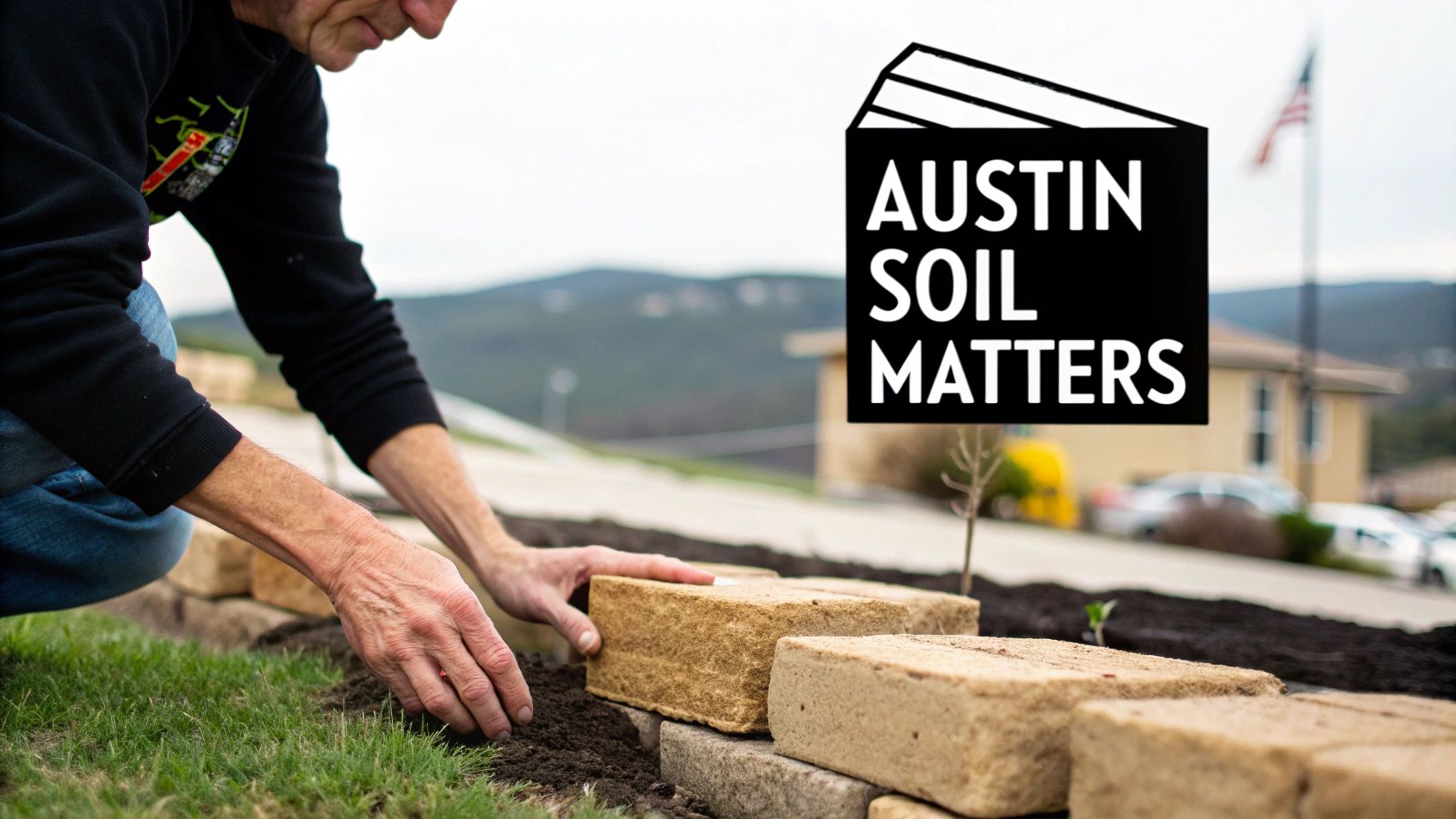
When you start planning a new patio, it’s tempting to pull up a how-to video online. The problem is, that video wasn't filmed in Central Texas. A technique that works perfectly in the sandy soil of California or the stable loam of Pennsylvania will fail spectacularly here. This is why finding a local expert you trust is the single most important decision you'll make for your home.
We've spent years getting this right, adapting our methods to the unique challenges of our environment. Our goal isn't just to install your patio; it's to be your trusted partner, arming you with the knowledge to understand what a truly durable, long-lasting project looks like.
Austin's Unique Soil And Weather Challenges
The ground beneath your feet is the real boss of any hardscaping project here. Austin is famous for its expansive clay soil, which acts like a sponge—it soaks up rain and swells, then shrinks and cracks during our long, hot summers.
This constant movement is the enemy of a flat, stable paver surface. Without the right preparation, you'll see problems like:
- Heaving Pavers: The ground literally pushes pavers up, creating an uneven mess and serious trip hazards.
- Cracking Joints: As the soil shifts, the sand between your pavers gets pulled apart, leaving them loose and unstable.
- Drainage Nightmares: Water pools on your patio or, even worse, gets channeled right back toward your house's foundation.
A true professional anticipates this. The solution almost always involves digging deeper and building a more robust, compacted base than any national DIY blog would ever tell you is necessary. We don't guess; we engineer a solution for your specific property.
A project’s success is built from the ground up. In Austin, this means engineering a base that can withstand our soil’s constant expansion and contraction, ensuring your hardscape remains stable for decades, not just a single season.
The Modern Yard Landscapes Difference
We treat every project as a custom job because, in this environment, it has to be. Our deep experience in Austin and the surrounding communities means we know that a one-size-fits-all approach is a recipe for failure. Just as businesses need a localized approach to connect with customers, which you can read about in these Top Local Marketing Strategy Tips, hardscaping requires a deep understanding of the local ground conditions.
We’re committed to being completely transparent. We want you to feel confident in your investment, which is why this guide breaks down the specifics of everything from material selection to drainage, all viewed through the lens of the Austin climate. The principles of great hardscaping are universal, but the application is intensely local—a philosophy we bring to every job, including our work with expert hardscapers in Lakeway, Texas.
Give us a call today, and let's talk about how we can build a beautiful outdoor space that's made to last right here in Central Texas.
Decoding the True Cost of Paver Installation in Austin
One of the first things Austin homeowners ask is, "So, what's this actually going to cost me?" It's a critical question, and we believe you deserve a clear, honest answer. The real cost of paver setting in Austin, TX, is an investment in your property's future, and it covers a lot more than just the stones you see on top.
Think of it like building a house. You wouldn't just pay for the lumber and drywall. You're investing in the concrete foundation, the structural frame, the plumbing, and the skilled team that puts it all together correctly. A paver project is exactly the same. The final quote is a reflection of a detailed, professional process designed to look great and, more importantly, to last for decades.
More Than Just Pavers: The Anatomy of a Quote
A surprisingly low quote is almost always a red flag. It usually means someone is cutting corners, and here in Austin, with our challenging clay soil, a cut corner is a future failure waiting to happen. A professional, trustworthy quote will always break down the costs, so you can see exactly where your money is going. We want you to understand every line item.
Here’s what a proper estimate from a reputable installer should be covering:
- Serious Site Preparation: This is the most critical part of the whole job. It means excavating the existing soil, often 6-8 inches deep, to get rid of that unstable clay and create a solid footprint for the project.
- A Rock-Solid Base Foundation: We don’t just dump some gravel and call it a day. We build a multi-layer base of compacted road base and limestone, engineered to distribute weight and resist the heaving and shifting our local soil is famous for.
- Precision Labor and Skill: This covers the time and expertise of our insured and experienced crew. It's the meticulous work of leveling the base, carefully laying each paver, making tricky cuts for a perfect fit, and installing heavy-duty edge restraints that lock the whole system together.
- High-Quality Materials: Beyond the pavers themselves, this includes the right kind of base material, leveling sand, robust edging, and the polymeric sand for the joints. That last part is key—it hardens like mortar to keep weeds out and ants from moving in.
You're not just buying pavers. You’re investing in the robust, unseen structure underneath that guarantees they won’t sink, shift, or buckle for decades to come.
Real-World Scenarios: Comparing Project Costs
Let's look at how this plays out in the real world. Imagine a simple, 150-square-foot rectangular patio on a flat, easy-to-access part of your yard. That’s a pretty straightforward job. The digging is simple, the paver cuts are minimal, and getting materials in and out is easy.
Now, picture a 500-square-foot paver driveway. This is a completely different beast. It requires much deeper excavation to handle cars, way more base material, complex cuts around a curved walkway or the garage entrance, and potentially tricky site access. The cost per square foot for that driveway is going to be higher. It has to be. That's why a one-size-fits-all price is a sign of an inexperienced contractor.
Sample Austin Paver Project Cost Breakdown (150 sq. ft. Patio)
To make it tangible, let's break down the costs for a small patio. You'll quickly see why the installed price is so different from just the material cost. This transparency is key to building trust.
| Cost Component | Typical Price Range | What This Covers |
|---|---|---|
| Pavers & Materials | $450 – $750 | The pavers themselves, base gravel, leveling sand, edging, and polymeric sand. |
| Labor & Installation | $1,050 – $1,650 | All site prep (excavation, hauling), base compaction, paver laying and cutting, cleanup, and disposal fees. |
| Total Estimated Cost | $1,500 – $2,400 | A complete, professionally installed patio ready for use. |
| Price Per Square Foot | $10 – $16 | The all-in price, which is the most realistic way to budget. |
As you can see, the materials are just the beginning. The bulk of the investment—often 60-80% of the final invoice—goes into the professional labor and extensive site work that ensures the project lasts.
A quote that seems too good to be true is often missing the most important part of the job: the foundation. We believe in showing you the full picture, ensuring you understand the value and longevity you're paying for.
For contractors, keeping all these details straight across multiple jobs is a huge challenge. Running a smooth operation is just as important as the work itself, which is why investing in the best CRM for contractors is a smart business move that ultimately leads to a better, more organized experience for the customer.
When you get a quote from Modern Yard Landscapes, we’ll walk you through every single line item. We want you to feel confident and fully informed, knowing your investment is in good hands. Give us a call, and let’s talk through a clear, honest plan for your project.
Our Proven Process for a Flawless Paver Installation
Seeing your vision for a new patio or walkway come to life is exciting, but how it gets built is what truly matters. The difference between a paver surface that looks great for a year and one that stands strong for decades lies entirely in the process. We believe in being completely open, so we're pulling back the curtain on the meticulous, proven steps we take for every single project.
There are no shortcuts to durability, especially not with the tricky soil here in Austin. Our method is a direct response to the challenges our local environment throws at us. By sharing our approach for paver setting in Austin, TX, we want you to feel confident that your project is being built to the absolute highest standard, designed to stand the test of time.
This diagram helps visualize how the different parts of a professional installation come together to form the total project investment.
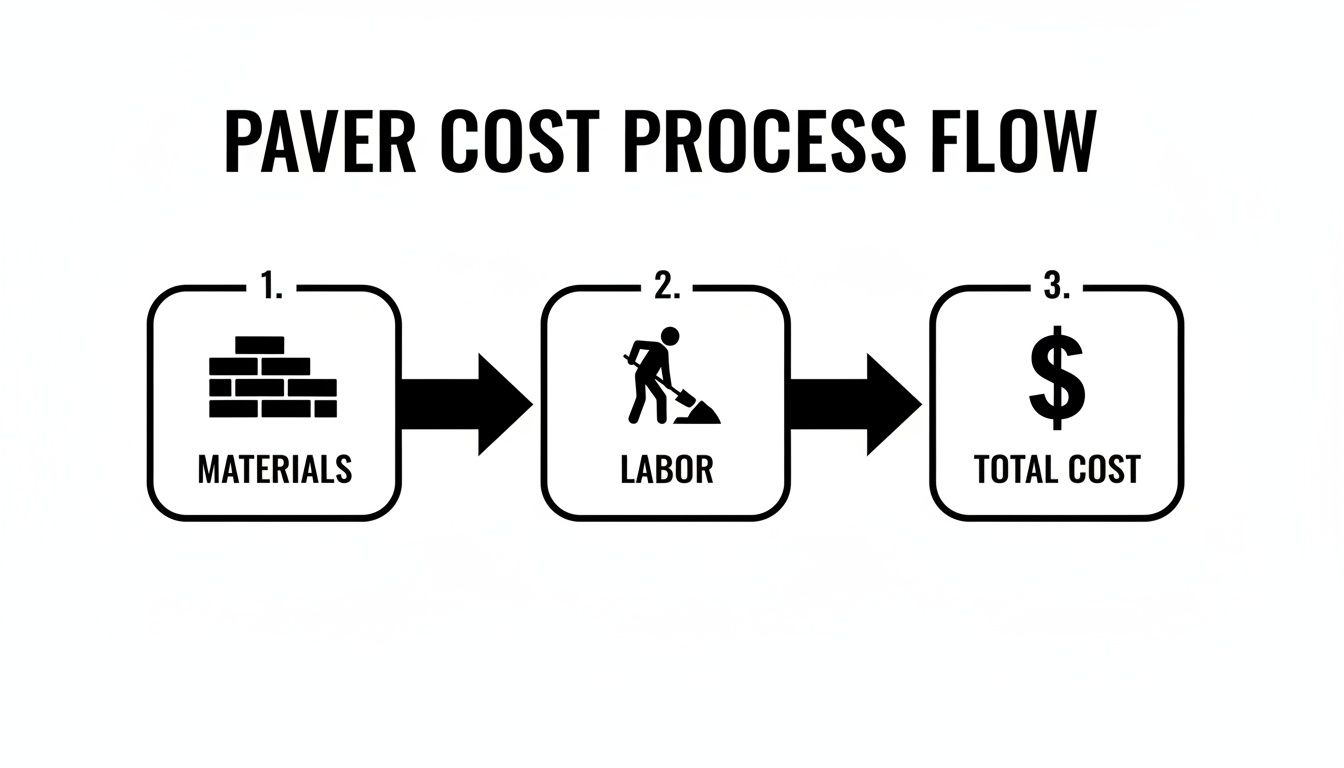
As you can see, the materials are just the beginning. It’s the expert labor and painstaking preparation that truly transform a pile of stone into a lasting outdoor living space.
The Foundation: A Battle Against Austin's Clay Soil
Everything starts with what's underneath. Austin's infamous expansive clay soil is the number one killer of paver projects, so our process begins by soundly defeating it. We don't just scrape the grass off; we perform a deep, thorough excavation.
For a standard patio, that means digging down at least 6 to 8 inches. This critical step gets rid of the unstable, shifting topsoil and gives us a clean slate to build a foundation that won't budge. It's more work, sure, but it's completely non-negotiable for a project built to last.
Engineering a Multi-Layer, Compacted Base
With the site excavated, we start building the real hero of your project: the base. This isn't just about dumping a layer of gravel. We construct a multi-layer foundation using a specific grade of crushed limestone road base.
Here’s our methodical approach:
- Layered Installation: We add the base material in 2 to 3-inch lifts, never all at once.
- Mechanical Compaction: After each layer goes down, we hit it with a heavy-duty plate compactor until it's rock-solid. This forces out air pockets and creates maximum density.
- Precision Grading: While compacting, we’re also engineering a subtle slope—usually a 1/4-inch drop per foot—to guide rainwater away from your house. This prevents pooling and protects your home’s foundation.
This bulletproof base creates a stable, interlocking platform that distributes weight evenly and resists the constant push-and-pull of the clay soil beneath it.
Precision Laying and Secure Edging
Once the foundation is perfect, we lay down a thin, precisely-leveled layer of bedding sand. This is the "cushion" that each individual paver is set into. Our crew meticulously places every stone, ensuring tight, consistent joint lines for that clean, professional look you’re after.
But just laying the pavers isn't enough. To stop the whole system from shifting or spreading apart over time, we install robust edge restraints. These are tough plastic or metal borders staked deep into the compacted base, creating a rigid frame that locks the entire patio in place.
An uncontained paver patio is like a book with no cover—eventually, the pages will start to spread apart. Edge restraints are the essential binding that holds the entire structure together permanently.
The Final Lock: Polymeric Sand for Weed-Free Joints
The final step is what secures the whole surface and protects it from the elements. Instead of using regular sand that washes out and becomes a breeding ground for weeds, we use a high-quality polymeric sand.
This isn't your kid's play sand. It’s a special blend that we sweep into the joints and then activate with a light mist of water. It contains a polymer that hardens almost like mortar as it cures.
The benefits are immediate and long-lasting:
- It stops weed growth cold by creating a solid barrier that seeds can't penetrate.
- It prevents ant hills and other insects from taking up residence in the joints.
- It locks the pavers together, creating a durable, unified surface that resists movement.
This meticulous, step-by-step process ensures every project we build is not just beautiful on day one, but structurally sound from the ground up for years to come. You can learn more about our commitment to quality in our guide to professional patio paver installation in Austin.
When you're ready to discuss a project built with this level of care, give us a call. We’d be happy to walk you through our process in person.
Choosing Paver Materials That Can Handle the Texas Climate
A beautiful paver patio is more than just skilled installation. It all starts with picking materials tough enough for the wild Austin climate. Between the scorching summer sun and those sudden, torrential downpours, the right pavers, base, and joint compounds are what make the difference between a hardscape you’ll love for decades and one that starts falling apart in a few years.
This is where trusting a local expert really counts. We’re not trying to sell you the most expensive stone. Our job is to guide you to the smartest investment for your home. We’ll break down why some materials thrive under the Texas sun while others will crack, fade, or get hot enough to fry an egg. You can trust us to steer you toward a choice that not only looks fantastic but performs perfectly year after year.
Paver Options Built for Austin's Heat and Rain
It's easy to get caught up in all the colors and styles when you're looking at pavers. Here in Austin, though, performance comes first. The two biggest things we wrestle with are heat absorption and durability against our crazy weather.
Here’s a practical look at the most common options we recommend and install every day:
-
Concrete Pavers: There’s a reason these are so popular. They're incredibly versatile, coming in a massive range of styles and colors. Modern concrete pavers are exceptionally durable, and we can guide you to specific lines designed for lower heat absorption. Their uniform shape also creates tight joints, which is a huge plus for paver setting in Austin, TX, because it helps keep the weeds out.
-
Natural Stone (Limestone, Sandstone): You can't beat the beauty of real stone. Native Texas limestone, for example, gives you that classic Hill Country look. But you have to be careful—darker stones can soak up an incredible amount of heat, making them impossible to walk on barefoot in July. For anything around a pool or a patio where kids will be playing, we’ll help you select lighter-colored stones as a much safer, more comfortable choice.
-
Porcelain Pavers: This is a premium choice, and it's catching on fast. Porcelain is incredibly dense, so it’s almost completely resistant to stains, fading from UV rays, and water absorption. Because it’s non-porous, it’s also less likely to be damaged by the rare freeze-thaw cycles we sometimes get.
The best paver isn't just about the look; it's about how it performs day-in and day-out. In Austin, a paver that stays cooler to the touch, holds its color, and won't crack under pressure is always the right choice. We help you find that perfect balance of beauty and brawn.
The Unsung Heroes Beneath Your Feet
While the pavers get all the glory, what’s underneath them is the real secret to a project that lasts. Skimping on the base or joint filler is a surefire way to end up with weeds, sinking spots, and shifting pavers. We simply refuse to cut corners on this.
For the base, crushed limestone road base is the only material we use in Central Texas. It's sourced locally, but more importantly, it compacts into a rock-solid foundation that stands up to our notoriously expansive clay soils. It’s the supportive layer that prevents the settling and heaving that ruins so many DIY or poorly-built projects.
For the joints between the pavers, we only use a high-grade polymeric sand. Regular sand is an open invitation for ants to build mounds and for rain to wash it right out. Polymeric sand, on the other hand, has a binding agent that activates with water. It hardens into a firm yet flexible seal that locks the pavers together, stops weeds cold, and resists erosion. It directly solves some of the biggest headaches Austin homeowners deal with.
A strong foundation is just as critical for other hardscape elements, too. You can see how crucial material choice and solid construction are by looking at these retaining wall design ideas.
We build our hardscapes as a complete system, where every single material is chosen to work together against our specific local challenges. This detailed approach ensures your investment is protected from the ground up.
Making Pavers, Drainage, and Turf Work Together
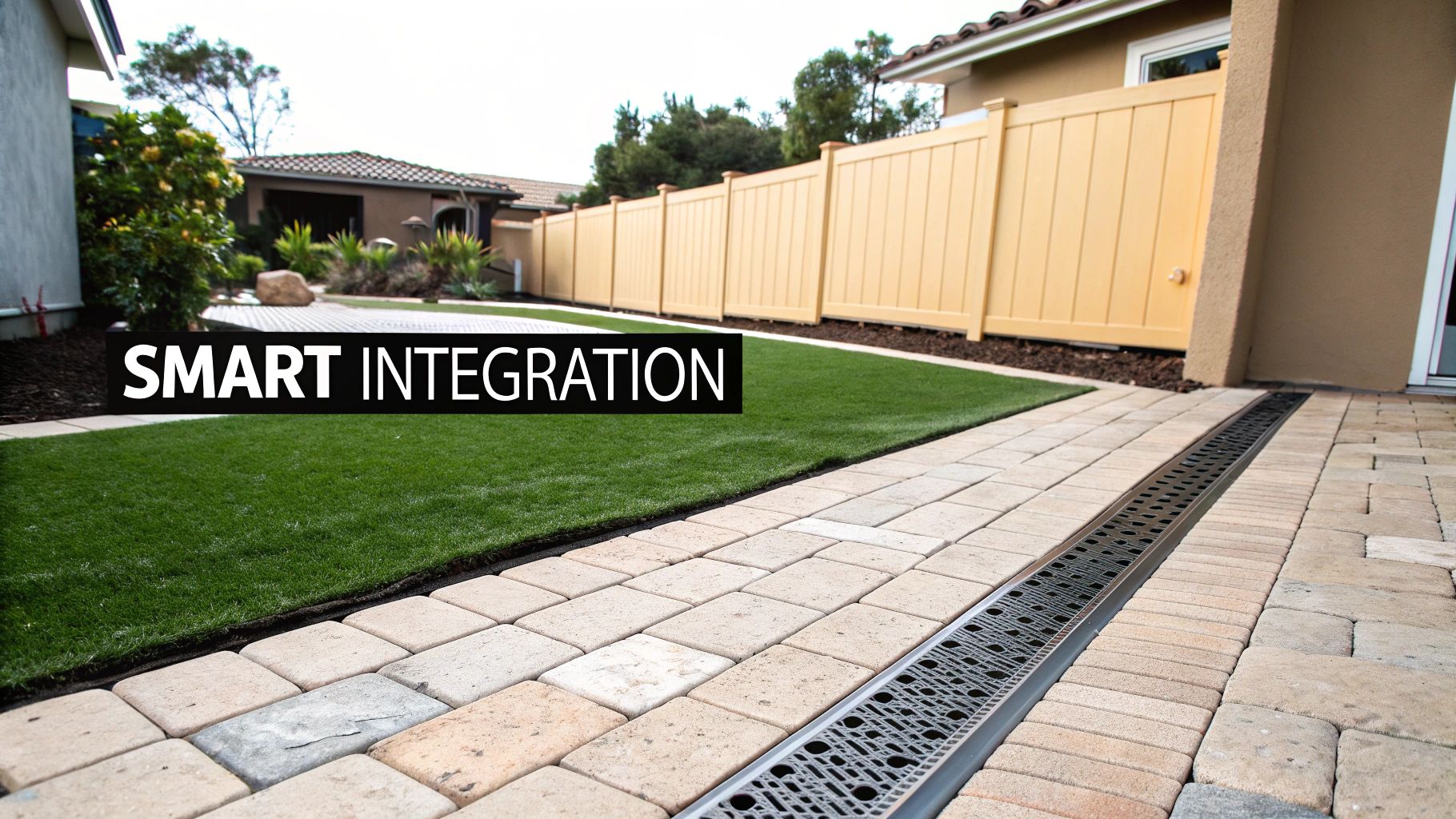
A paver patio doesn't exist in a vacuum. It has to play nice with the rest of your yard. A beautiful hardscape can quickly turn into a massive headache if it traps water against your foundation or creates an ugly, clunky border with your lawn.
The best installations are about seeing the big picture—how every piece of the puzzle fits together to create a backyard that’s not just beautiful, but truly functional. It's less about just laying stones and more about creating an integrated outdoor system designed to solve problems before they even start. We handle the entire process so you don't have to worry about a thing.
Taming Austin's Intense Rainstorms
In Austin, proper drainage isn't just a nice-to-have; it's an absolute must. Our sudden, torrential downpours can turn a poorly planned patio into a swimming pool right next to your house. That’s why a huge part of our paver setting in Austin, TX, process is built around smart water management.
We don't just slope the pavers and call it a day. We look at your yard's unique topography to figure out where the water wants to go.
- For yards that already have soggy spots, we can design a system where the patio's slope channels water directly into a French drain or a sleek, modern channel drain.
- In areas prone to standing water, we often recommend permeable pavers. These let rainwater soak right back into the ground, which dramatically cuts down on runoff.
Thinking ahead like this protects your home and turns a potential liability into a well-managed part of the landscape. For a deeper dive into how these systems work, take a look at our guide on effective drainage solutions for yards.
We see drainage as a design opportunity, not an afterthought. A well-designed paver surface should be your home's first line of defense against water damage, actively moving every drop of rain exactly where it needs to go.
The Perfect Marriage of Pavers and Artificial Turf
There’s nothing quite like the clean, modern look of crisp paver lines next to vibrant green turf. But getting that flawless transition isn’t easy. If you cut corners, you’ll end up with a messy, shifting border that you'll be fighting with forever.
We’ve perfected the art of creating a seamless, bulletproof connection between our paver installations and high-quality artificial turf. The secret? Commercial-grade steel edging.
This isn't the flimsy stuff you find at a big-box store. This heavy-duty border is staked deep into the compacted base, creating an unmovable frame that does two critical jobs:
- It locks the paver patio in place for good, preventing any shifting over time.
- It creates a perfectly clean, sharp line for the turf to butt up against.
This technique completely eliminates that sloppy look of mulch washing onto your patio or grass creeping into the paver joints. It’s a small detail, but it makes all the difference in the final look and long-term durability of your backyard. The result is a clean, low-maintenance space that looks perfectly manicured all year round.
With Austin’s residential construction market always buzzing—regional reports recently noted around 3,929 residential permits—homeowners are looking for contractors who get these details right. This is why our quotes are so comprehensive; they account for the site prep and drainage work that’s absolutely critical in this competitive market.
When you work with us, you're not just getting a paver installer. You're getting a team that knows how to make your entire yard work in perfect harmony. Give us a call, and let's talk about creating a beautiful, functional, and fully integrated outdoor space you'll love for years to come.
Answering Your Austin Paver Questions
At this point, you've probably got a few questions buzzing around. That's a good thing! It means you're serious about doing this right. We've been building paver patios and driveways in Central Texas for a long time, and we've heard just about everything.
This is where we get into the nitty-gritty. Think of it as a friendly chat where we give you the straight scoop on the most common questions we hear from homeowners just like you.
How Long Does A Typical Paver Patio Installation Take?
We understand you want your yard back as soon as possible, and our team is built for efficiency and precision. For a standard patio, say in the 200-300 square foot range, you can expect our crew to be in and out in about 3 to 5 days. That's assuming the infamous Texas weather plays nice, of course.
That 3-5 day window isn't just for laying the stones. It’s the entire process, done right:
- Tearing out any old concrete or patchy grass.
- Excavating and building up the multi-layer, compacted base—the most critical part!
- Carefully laying every single paver to get the pattern just right.
- Cutting the borders, installing hidden edge restraints, and locking it all in with polymeric sand.
We hate surprises as much as you do. That’s why our proposals always include a clear timeline. You’ll know exactly what’s happening from the moment our trucks pull up until you're firing up the grill on your beautiful new patio.
Will I Need A Permit For A Paver Patio In Austin?
This is a fantastic question, and the answer usually makes homeowners breathe a sigh of relief. For most paver patios, walkways, or even driveways, you do not need a permit from the City of Austin. The city is mainly concerned with bigger structures or anything that dramatically changes how water flows off your property.
Now, there are a few exceptions. A permit might be required if your dream project involves:
- Building a retaining wall over a certain height.
- Majorly re-shaping the slope of your yard.
- Connecting anything to city utility lines.
Don't sweat the details, though. That's our job. We check every project against city codes from day one. If a permit is needed for any reason, we handle the entire process—from the paperwork to the inspections—so you don't have to.
How Do You Ensure Proper Drainage For A New Paver Surface?
Here in Austin, with our clay soil and sudden downpours, drainage isn't just a feature; it’s everything. Getting it wrong is simply not an option for us. Our first line of defense is building a subtle, almost invisible slope into every single project—typically a quarter-inch drop for every foot of patio. This gentle grade is all it takes to steer rainwater away from your foundation and prevent pooling.
Poor drainage can sink the most beautiful paver installation and even put your home's foundation at risk. We don't just build patios; we engineer custom water management systems that protect your entire property.
For trickier yards with existing water issues, we bring in the heavy hitters. We can seamlessly integrate solutions like French drains or channel drains right into the paver design. This ensures that even during a classic Texas gully-washer, the water has a clear, safe path to exit your property.
What Maintenance Will My New Paver Patio Need?
One of the best parts about choosing pavers is how little you have to fuss over them. We build them to handle anything your family, friends, and the weather can throw at them. Honestly, the main "maintenance" is just sweeping it off or giving it a quick rinse with a hose to clear away leaves and dirt.
Every couple of years, you might want to eyeball the sand in the joints. In the high-traffic spots, it can sometimes settle a bit. Topping it off is an easy DIY task that keeps weeds from even thinking about sprouting.
For those who want maximum protection, we also offer a sealing service every 3-5 years. A professional-grade sealer is a great way to guard against stains from spilled drinks or grill grease and really makes the natural colors of the stone pop.
Ready to stop wondering and start planning? At Modern Yard Landscapes, we’re here to put our Austin-specific expertise to work for you. We are committed to earning your trust by delivering a superior process and a stunning final product. Let's schedule a time to walk your property, talk about your vision, and design an outdoor space you'll love for years to come.